

Individualised respiratory care is essential, both for optimal clinical outcomes and for supporting sustainability in practice.1 One person navigating the daily challenge of balancing diverse patient care with the many other demands of clinical practice is Toby Capstick, a Consultant Pharmacist specialising in respiratory care at the Leeds Teaching Hospital NHS Trust. He has extensive experience treating patients with asthma and COPD (chronic obstructive pulmonary disease) and shares his perspectives on optimising respiratory care for patients, while also considering the sustainability of their treatment.
“There isn’t a one-size fits all”
“I often say whether it’s a group of patients or healthcare professionals, look, you’re different from the person you’re sat next to and they’re different from the next person, and the next one. So, what’s right for you? It doesn’t necessarily mean it’s going to be right for everyone.”
Differing patients means different needs to balance, one of which is the environment.1
We all know that sustainability is a key topic these days, particularly with the NHS setting its net-zero carbon emission target for 2045.2 It’s no wonder, with healthcare making up 5.2% of greenhouse gas emissions worldwide.3 By comparison, aviation is estimated to contribute between 2-5% of greenhouse gas emissions globally.3 Environmental impact is an important consideration, and many patients would like a sustainable treatment, as identified in a recent NHS survey, but this is just one consideration.4,5
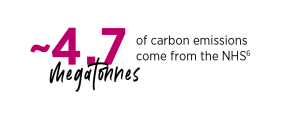
The use of inhalers and anaesthetic gases make up 20% of the NHS’s direct emissions.6 70% of all UK inhaler emissions are caused by short-acting beta-2 agonists (SABAs), but the environmental impact of respiratory care beyond inhalers might surprise you.5,7-10 We asked Toby his thoughts on balancing different prescribing priorities.
“One of the big factors that has been really pushed for the NHS over the last few years has been the environmental impact of inhalers. And obviously, that’s really, really important. One of the key agendas for the NHS is to reduce their carbon footprint, and inhalers form a key component of that. But for me, my priority is and always has been the patient in front of me.”
So, how do we achieve disease control and sustainability simultaneously?
A recent BMJ publication states that controlling respiratory disease through individualised care by default also helps healthcare professionals to meet sustainability goals.8 Toby explains his approach to achieving both.
“You have to go with the right device for each patient. If they’re not controlled, they’re going to exacerbate. They’re going to pitch up to the GP, to A&E, they’re going to get admitted to hospital. And that is going to have a much higher carbon footprint [than if they are controlled].”
“For me, if we’re going to change somebody’s inhaler, I need it to be for the right reason – that they’re uncontrolled or there is a clinical reason for it. There is a definite incentive in trying to get people to use dry powder inhalers, more from the carbon footprint perspective. Whenever I talk to people about switching, I say don’t do a blanket switch. If you’re going to switch people, focusing on it for clinical grounds is your priority. Yes, the environment’s in there. But when you look at inhaler use, most of our pMDIs are SABAs.”
“It’s uncontrolled patients, they’re driving the carbon footprint of inhaler use. And it’s not their fault”
“If we can optimise a patient’s treatment, whether it’s asthma, COPD, and get them on inhaler devices and the regimens according to the latest guidelines, that’s going to optimally control their disease, it will reduce their SABA use. Let’s get those people who are poorly controlled and sort them first.”
It seems clear that switching inhalers for environmental reasons isn’t enough.1,11,12
The gold standard is matching the right treatment to the right patient.1,12 But what does that look like in practice for healthcare professionals like Toby?
“If a treatment isn’t right for a patient, if they don’t like it, they’re not going to use it. If they need a pMDI, it might have a higher carbon footprint, but if it prevents them coming to the hospital, it reduces the overall carbon footprint and expense for that whole patient journey.”
“I do think sustainability comes as a result of doing the right things for the patient. And that’s my mantra.”
“If you do it the other way and just think the environment is more important than the patient, you’re not doing it for the patient’s best interests. So, if you can get everything right from day one, it’s going to be better all round for your patients and for the sustainability agenda.”
A vicious cycle
Respiratory care and its subsequent impacts can be a vicious or virtuous cycle,4,13,14 but according to Toby, they are inescapably interconnected.
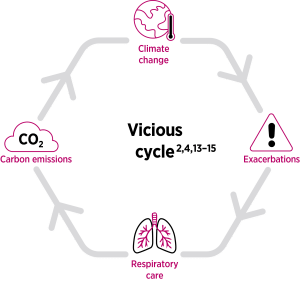
“It’s wrapped up into one. It’s interlinked and you can’t do one without the other.”
“I think if you were to go down prioritising the cost or sustainability, I think things unravel because you’re not doing it for the right reasons. If you prioritise patient outcomes first, it’s going to have a better financial and environmental impact.”
With optimising treatment to minimise exacerbations being the top priority, what does that really mean for a patient’s day-to-day life?
We asked Toby what feedback he hears from his patients.
“I think for the patient, it’s that feeling that they’re getting their life back and they’re going to be able to do all their normal activities, like going to school or exercise or work.
With asthma patients, if you can actually address [their condition], it’s going to have that positive wellbeing for the patient, as well as preventing them exacerbating. I think emotionally it’s better for them. I’ve had a few patients now where they’ve come back to me and said, “well, you know what, I was a bit sceptical about [treatment], but I gave it a go and it’s improved my symptoms. I’m not getting as wheezy or breathless.”
With COPD, it can be quite frightening for patients during exacerbations. We see a lot of times people get quite anxious, particularly [those with more] severe COPD. So, if you can get their symptoms better managed and prevent those exacerbations, it’s going to have that onward benefit for their overall wellbeing.”
“When you get those patient stories, even just those little nuggets about how they’ve benefited, it highlights that what we do really does make a difference.”
In the UK, over 7 million people have an asthma diagnosis, and 1.4 million have a COPD diagnosis.16,17
Every case and patient is different, with varying needs and preferences.1,5 If it’s all about finding the right fit for each patient to provide individualised care, then do healthcare professionals need to have access to a broad range of treatments? 1,5,16 Is choice really crucial, for both the NHS and patients? Toby shares his thoughts with us.
“Having different inhalers gives us that opportunity to find the right device for the right patient and the right drug for the right patient.
It means you can find a suitable inhaler that each individual patient can use and is happy to use and that’s going to optimally control their disease, whether it’s asthma or COPD. By having that range, you’re preventing exacerbations and reducing their reliever use, so there is going to be that onward benefit in reducing environmental impact.”
“Sometimes it will be a dry powder inhaler, sometimes it will be a pMDI.”
“Ultimately, it’s for that individual patient. You’re going to find a device they can use and that will be the lowest carbon footprint device for them.”
Balancing patient needs, clinical outcomes and sustainability isn’t always straightforward.
Toby leaves us with some practical advice and encouragement for those facing this challenge every day.
“The patient that is in front of you is the most important thing. And what you’re trying to do is improve their treatment outcomes, and it’s going to improve the overall carbon footprint associated with their health, disease and medicine use. So, if you can focus on that patient, get that right, then you’ve done the job for that patient.”
“And if you could do that for each patient, happy days.”
At Chiesi, we agree. By continuing to provide individualised respiratory care for your patients, we believe that you’ll be helping to optimise their disease control, which could reduce the impact on the environment and help meet the NHS net-zero emissions target.1,6,18-20
For more information about the impact of disease control on sustainability, please see our useful infographic